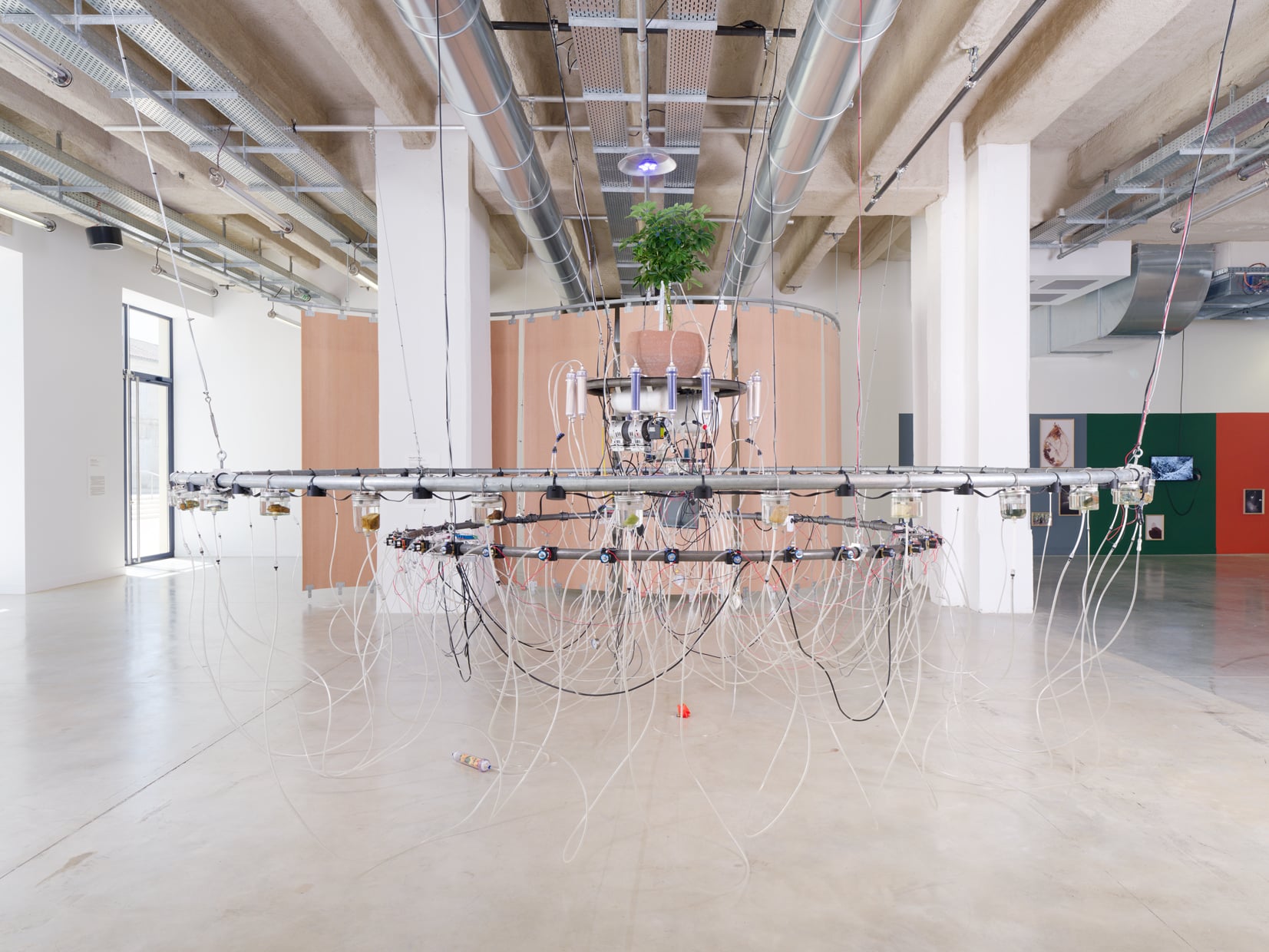
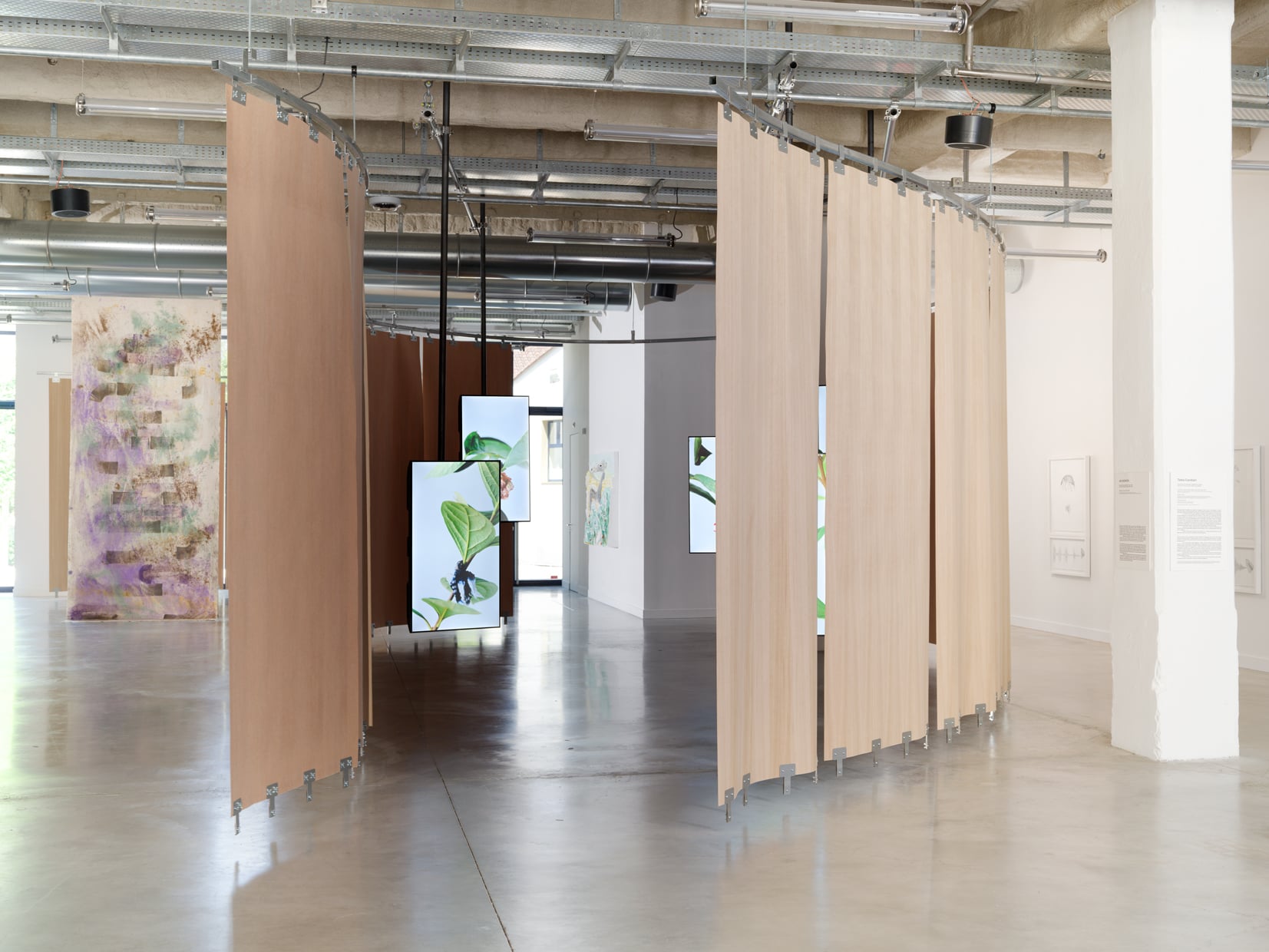


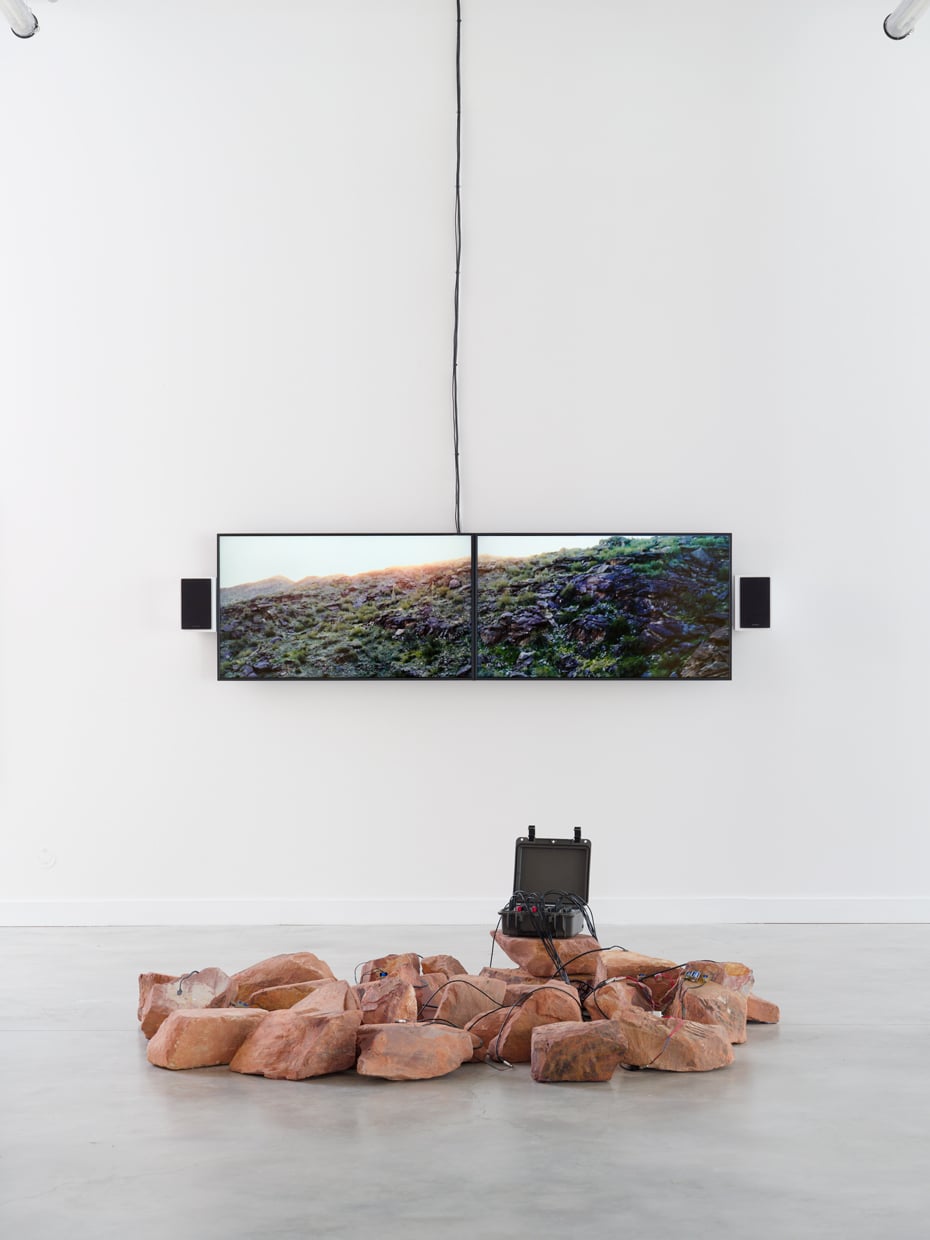
From top to bottom
Hyperpnea Green, 2024 – Bagus Pandega. Courtesy of the artist and ROH (Jakarta, Indonesia) © Aurélien Mole
Passing her a piece of cloth, 2022 – AKI INOMATA. Courtesy of the artist and Maho Kubota Gallery (Tokyo, Japan) © Aurélien Mole
The Book of Flowers, 2023 – Agnieszka Polska. Courtesy of the artist.
Alfil Relief/Elephant Relief (V03), 2021. Courtesy: Lin May Saeed Estate; Chris Sharp Gallery, Los Angeles; Jacky Strenz, Frankfurt/Main
La Fondation d’entreprise Martell thanks
Galleries and lenders :
Estate de Lin May Saeed & Jacky Strenz Gallery
Fondation Louis Vuitton
Maho Kubota Gallery
ROH Gallery
Sponsors :
EssarBois
Terreal-Wienerberger
The Monkey and the Clay
30 May 2026 - 3 January 2027
At the intersection of play, poetry and science fiction, the exhibition The Monkey and the Clay brings together nine international artists who explore the theme of collaboration between species. Through fable and imagination, the exhibition sets natural, human and technological productions in dialogue, sketching out new forms of alliances with the living world. Presented within a scenography evoking the forest, these hybrid works—installations, films, sculptures and sound pieces—contribute to a broader conversation on collective transformation, invoking concepts ranging from ecological compensation to eco-futurism.
‘We must help one another; it is the law of nature.’
The Donkey and the Dog
Collective exhibition with : Tania Candiani (Mexico), AKI INOMATA (Japan), Bagus Pandega (Indonesia), Agnieszka Polska (Poland), Lin May Saeed (Iraq-Germany), Shimabuku (Japan), Jessica Warboys (United Kingdom), Trevor Yeung (Hong Kong), Robert Zhao Renhui (Singapore).
Guest Curator : Emilie Villez
Exhibition Design : Atelier CRAFT
Graphic Design : Théo David Gehin
In order to better coexist within a ‘more-than-human’¹ world, human beings are learning to redefine their place within the ecosystem. Drawing on both theoretical debates and practical experimentation, contemporary artists increasingly position themselves not as conquerors of nature, but as collaborators.
Reflecting its title which embodies an interaction between the animal and the mineral, The Monkey and the Clay is permeated by the concept of interspecies interdependence, following ecological currents of thought that decentre the human. Challenging the notion of human exceptionalism and dominance over non-human species, the term ‘more-than-human’ is used across the humanities and social sciences to mark a rupture with hierarchical understandings of life.
This entanglement – animal, vegetable, mineral, atmospheric – describes a complex web of relations where no entity exists in isolation, and where every action ripples through a multitude of interconnected beings. The evolution of the word ‘ecology’ itself reveals this shift: while scientists originally defined the term as the study of interactions between living organisms and their environment, it gradually morphed into a commitment to the conservation of territories and species, before becoming a political necessity in the 1970s.
Influenced by the avant-garde positions of Land Art, environmental activism, and non-Western holistic thought, contemporary artists are pursuing more horizontal relationships, even envisioning co-creation with the non-human. Yet these collaborative bonds are complex, often unpredictable, and occasionally verge on instrumentalisation. How can we be certain of their reciprocity?
The exhibition explores these questions through artistic practices that reframe, and even bring a sense of play to, our modes of production and coexistence.
The works on display defy traditional representations of nature; rather than offering solutions, they seek to foster alternative ways of thinking. To mend fractured links, these artists engage in a process of immersion and listening, raising questions of proximity and kinship (Tania Candiani, Shimabuku) and the role of chance within the co-creative process (AKI INOMATA, Jessica Warboys, Trevor Yeung). Striving to counter fatalism, the exhibition highlights practices that cultivate a political and ecological imagination: some offer counter-narratives (Robert Zhao Renhui, Lin May Saeed), while others construct speculative fictions through technological tools (Agnieszka Polska, Bagus Pandega).
¹ The term first appeared in David Abram’s The Spell of the Sensuous: Perception and Language in a More-Than-Human World (1996). French translation: « Comment la terre s’est tue. Pour une écologie des sens , Ed. La Découverte, 2013
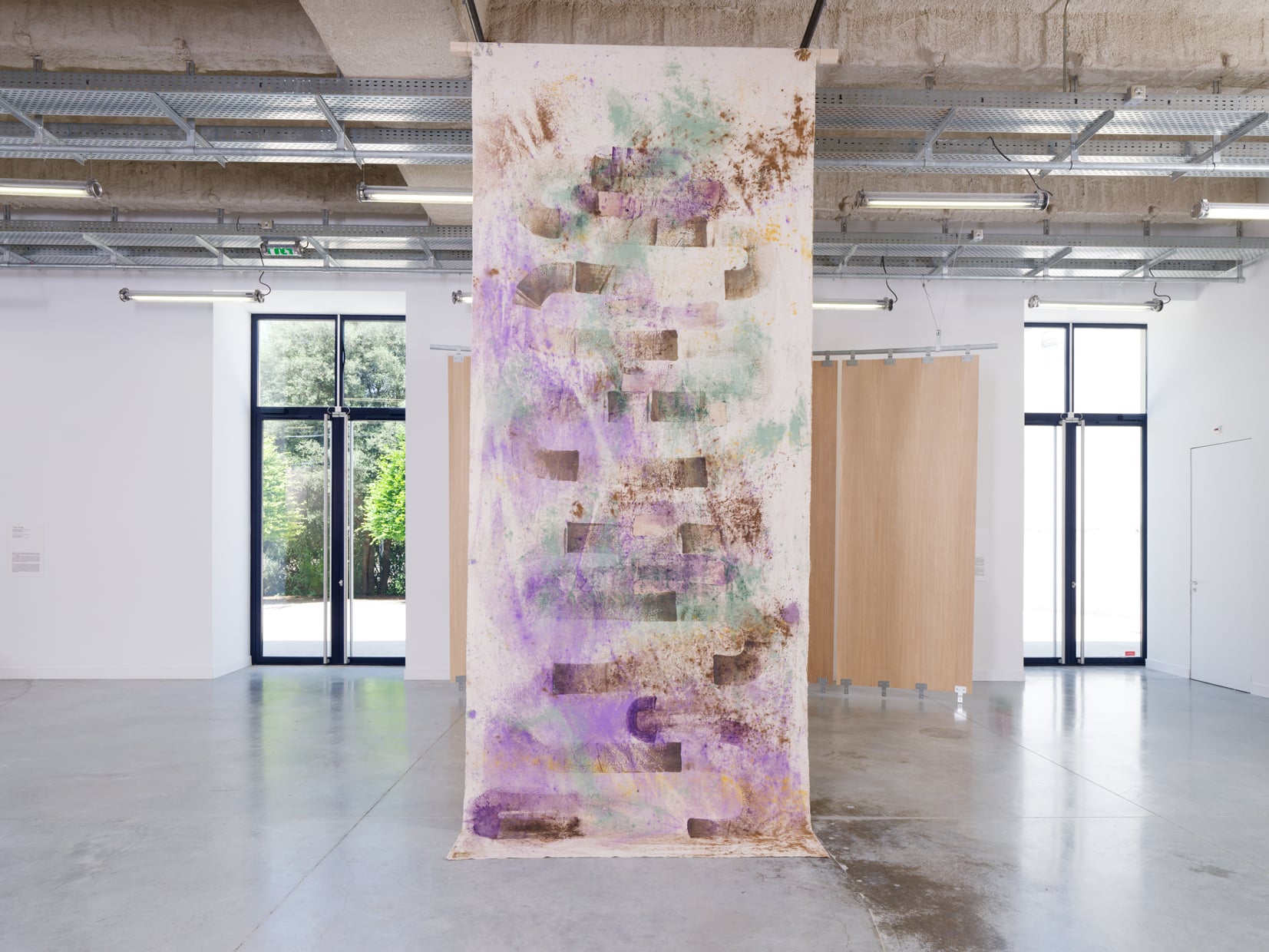
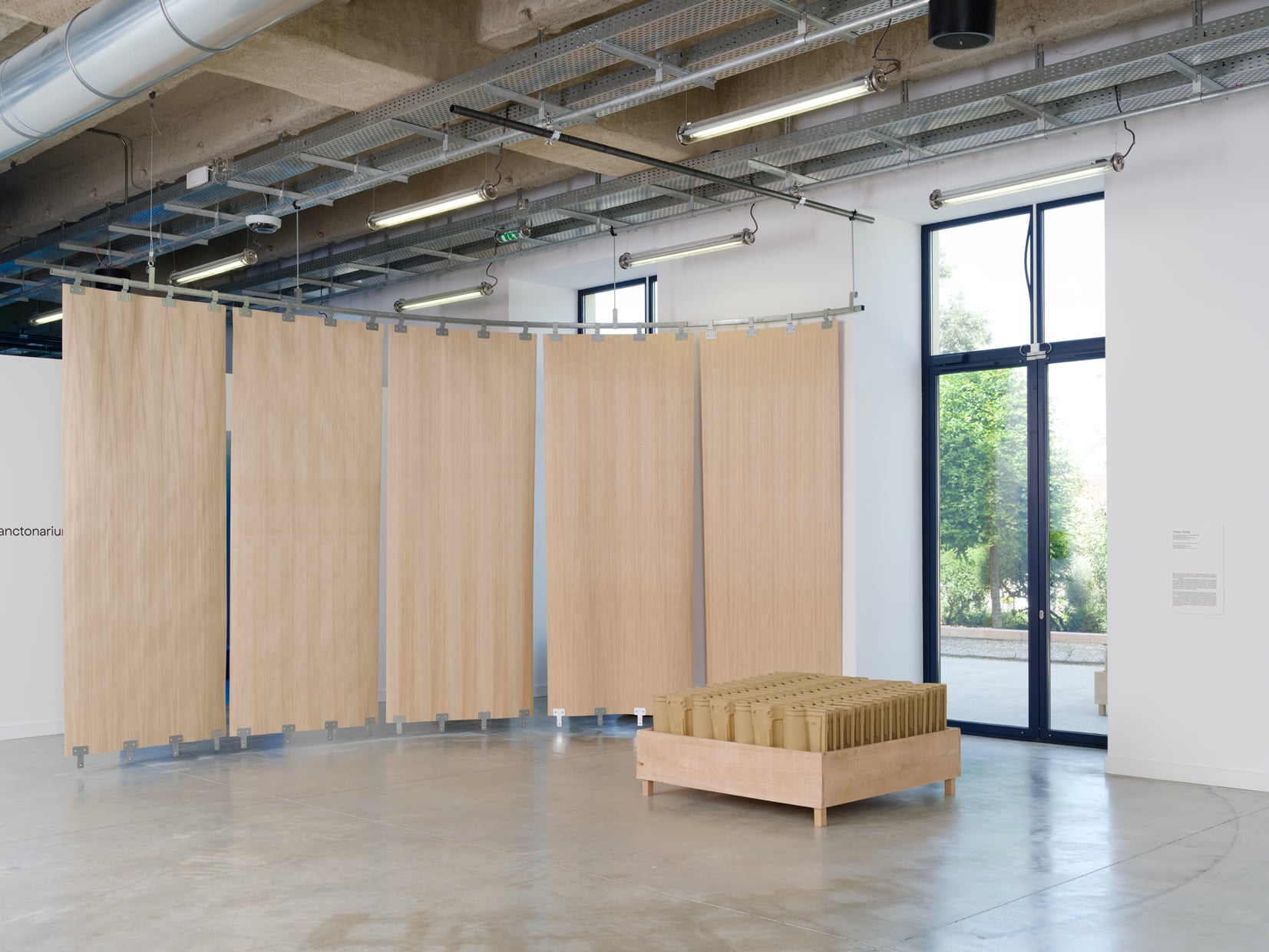
From left to right – © Aurélien Mole
First Concert video and Percutor 2020 – Tania Candiani. Courtesy: Tania Candiani Studio
River Painting, Charente, 2026 – Jessica Warboys. Courtesy of the artist and Galerie Gaudel de Stampa
Earth to Earth (Terres-de-Haute-Charente), 2026 – Trevor Yeung. Courtesy of the artist and Galerie Joseph Allen